
In 2022, the City Engineer collaborated with T&M Associates to develop a concept plan for safety improvements on Chestnut Avenue from Main Road (County Route 555) to Delsea Drive (NJ 47). Also, City Council supported a road diet and substantive safety improvements along this stretch of Chestnut Avenue.
This project will convert Chestnut Avenue from the existing 4-lane, 50’ wide multilane highway configuration into a 4-lane thoroughfare with a center two-way-left-turn lane between S. East Blvd. and 7th Street. At most existing signalized intersections a 12’ wide left-turn lane will be added.
In addition to the modifications to the existing roadway lane configuration, the entire pavement will be rehabilitated, with either full depth material or milled and overlaid. Signing will be upgraded or replaced, and all pavement markings will meet current standards.
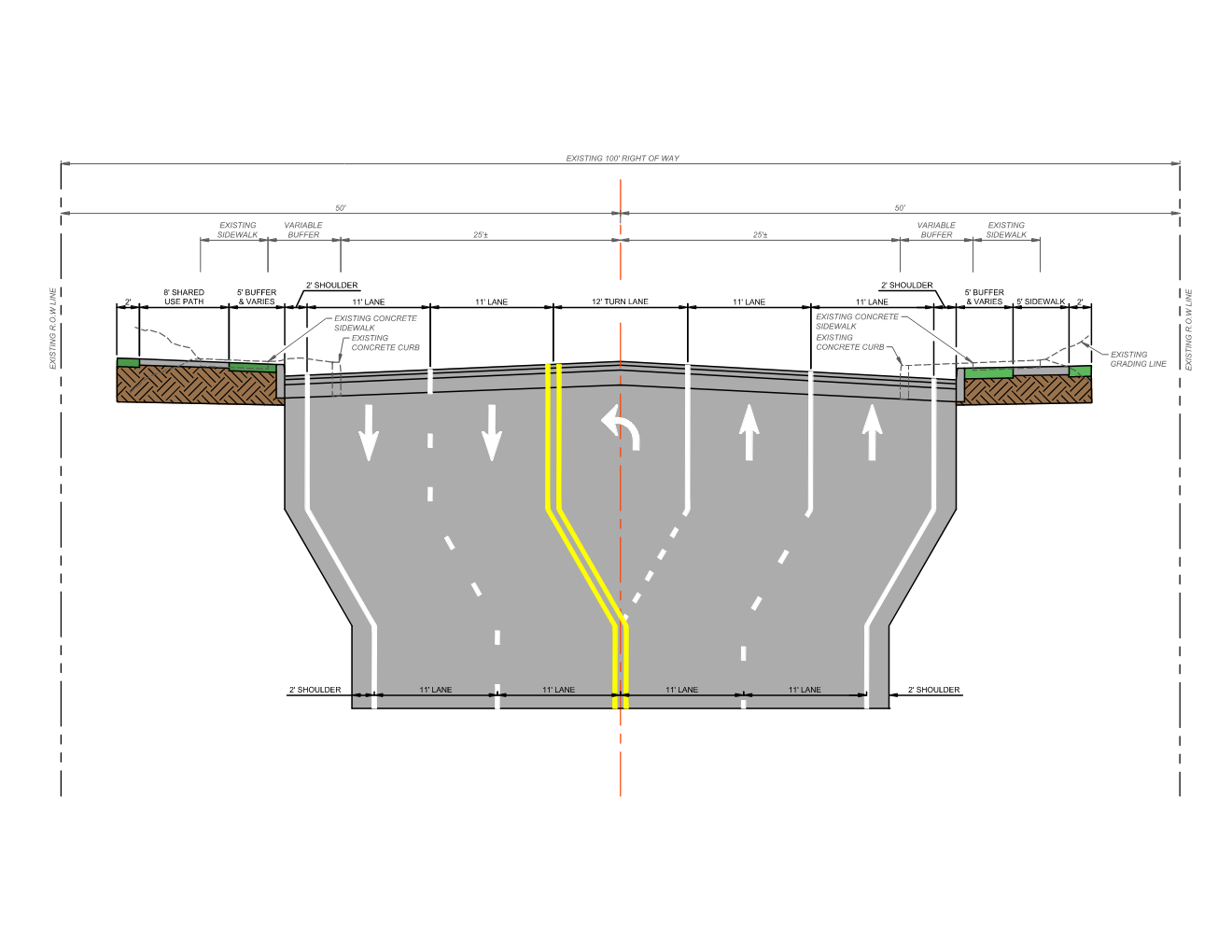
Click To Enlarge
To improve multimodal accessibility, an 8’ shared-use path will be constructed on the north side of the roadway and a 5’ sidewalk will be constructed on the south side to facilitate non-motorists through the corridor.
The traffic signals within the corridor, excluding the traffic signals at the intersections with Delsea Drive (NJ Route 47) and Main Road (CR 555), will be reconstructed using currently accepted traffic engineering practices. The traffic signals throughout the corridor will be coordinated.
The storm drainage systems will be brought to current standards in accordance with the 2015 NJDOT Roadway Design Manual.
Your input is critical to the success of this project. All stakeholders are invited to attend an upcoming community meeting. The City of Vineland invites you to share your ideas, concerns, and feedback on this project.
A public meeting was held on July 20, 2026. Following is a link to the presentation information:
Public Information Center July 20 Meeting Transcript
Final design will begin soon, and construction is tentatively scheduled to begin June 2027.
Chestnut Avenue Plan
Public Information Center September 11 Meeting Video
SJTPO Cumberland County Bike Ped Safety Action Plan
FHWA Proven Safety Countermeasures Flyer
FHWA Proven Safety Countermeasures Booklet